Not Just an Indian Summer: Four Curries That Will Change the Way You Think About Spice
Most of us grew up thinking of curry as a single thing – something Indian, something with a particular colour and heat level, spooned over rice on a Friday or Saturday night. And while Indian curry is extraordinary in all its forms, it represents perhaps a hundredth of what the word actually covers. Around the world, the idea of slow-cooking meat, vegetables, or fish in a deeply spiced sauce has evolved independently across dozens of cultures, producing dishes so different from one another that calling them all “curry” feels almost like a category error.
Here are four of our favourites and each one a genuine surprise, each one built on ingredients you can find right here at Leo Foods.
Matira Curry from Rajasthan, India
The Thar Desert has unforgiving terrain, extreme heat, scarce water, and yet the cooking of Rajasthan is some of the most inventive in all of India, precisely because it had to make something extraordinary out of very little.
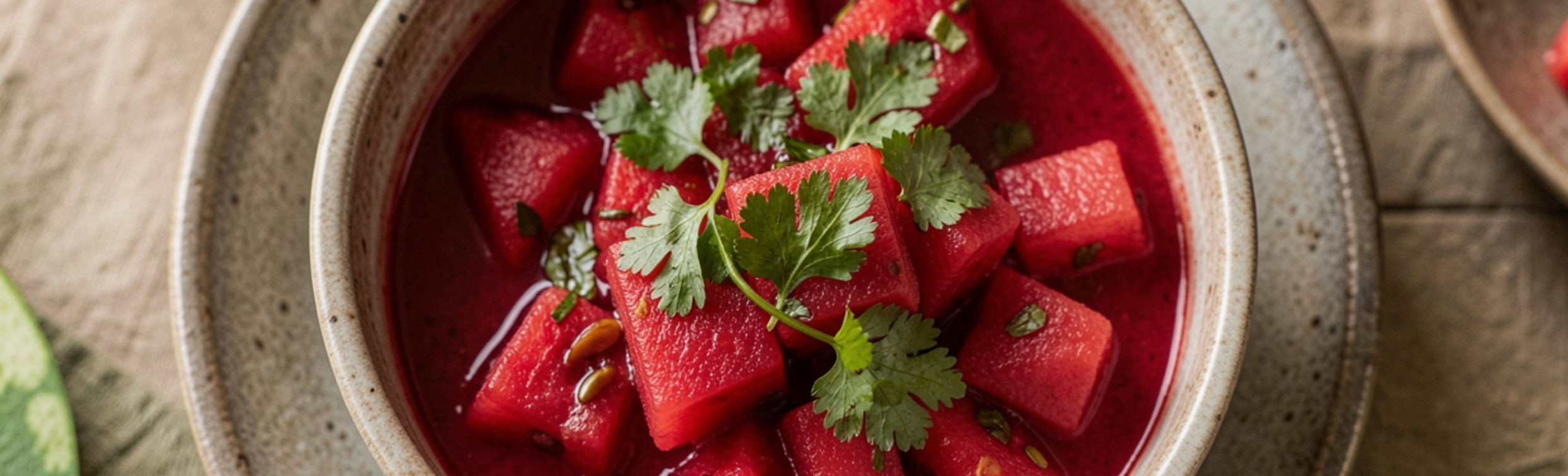
Matira curry is a perfect example. In a region where fresh vegetables are hard to come by, watermelon, including the rind that most people throw away, becomes the main ingredient.
Chunks of both flesh and white rind are simmered in a spiced broth of cumin, coriander, turmeric, garlic, and Kashmiri chilli – the last of which gives it that distinctive deep red colour without overwhelming heat. The result is a dish that sits somewhere between sweet, sour, and warmly spiced, with the rind softening into something almost translucent and tender.
It sounds improbable until you eat it. The watermelon flesh breaks down into the sauce and adds a natural sweetness that plays beautifully against the spice. For a restaurant kitchen, it makes a genuinely compelling vegetarian special in summer – unusual, visually striking, and built almost entirely on pantry ingredients. At home, it’s a conversation piece that takes under an hour to make.
Ghormeh Sabzi from Iran
If Matira curry is defined by restraint and ingenuity, Persian ghormeh sabzi is defined by abundance – in particular, an abundance of herbs. A rich, deeply aromatic stew of lamb or beef slow-cooked with mountains of dried herbs, kidney beans, and an utterly distinctive ingredient – dried limes.
The dried lime is one of the most fascinating flavours in Middle Eastern cooking. Whole or cracked and added to the pot, it releases a sour, slightly smoky and intensely citrusy note that is unlike anything a fresh lime can achieve. Combined with the herb mixture – fenugreek, parsley, and dried fenugreek leaves – and cooked slowly in ghee, the result is a stew that is both fresh and deeply earthy.
We stock both dried black limes and the dedicated Sabzi Ghormeh herb blend, which takes the guesswork out of the herb mixture entirely.
It’s excellent for large-batch cooking as it improves with time and reheats beautifully. Plus, it also happens to be naturally gluten-free!
Moryechi Xacuti from Goa, India
Goa’s cuisine is the product of four hundred years of Portuguese influence layered over a pre-existing tradition of fierce, coconut-heavy Konkani cooking. The spice blend of roasted coconut, poppy seeds, dried chillies, and a long list of whole spices, produces a sauce that’s rich and complex.
The standard version uses chicken. Moryechi xacuti, the Goan adaptation, uses shark – a nod to the fishing communities along the coast who needed to make use of whatever the sea provided. The deep, tangy, coconut-dark sauce was designed to work with strong-flavoured fish, and it does so brilliantly.
For most kitchens, firm white fish or large prawns make an excellent substitute with this one. The foundation of the dish is the xacuti paste itself: desiccated coconut dry-roasted until golden, blended with coriander, cumin, turmeric, Kashmiri chilli for colour, and black pepper. The resulting paste, fried in oil and loosened with water or coconut milk, becomes one of the most distinctive curry bases in Indian cooking – unmistakably Goan, quite unlike anything from the north.
Chocolate Curry from Japan
Unlike the thin, fragrant broths of Thai cooking or the complex spice pastes of India, Japanese curry is built around a roux, using butter, flour, and curry powder cooked together until thick, which gives it a gravy-like richness and a sweetness that comes partly from grated apple and a touch of honey. It is comfort food and enormously popular across the country in a way that has little to do with the Indian curries that originally inspired it.
The chocolate twist takes that already rich base and pushes it further. A square or two of dark chocolate stirred into the finished roux adds bitterness, depth, and a slight sharpness that balances the sweetness and brings a roundness to the whole dish. It is the kind of trick that professional pastry chefs will recognise – dark chocolate does the same thing in savoury mole sauce – but applied here to one of Japan’s most popular everyday dishes.
The key is using chocolate with sufficient cocoa content to contribute bitterness rather than sweetness. From our range, the cocoa powder and dark chocolate products sit alongside the cumin, coriander, turmeric, and cardamom that go into the spice blend. Serve over Japanese short-grain rice for the full experience, or use basmati if that’s what you have to hand.
What These Four Dishes Have in Common
Each of these curries emerge from a specific set of constraints, whether geographical, cultural, or economic, and they each solved the problem of how to cook something extraordinary with the ingredients at hand.
That’s exactly the kind of thinking we love at Leo Foods. We’ve spent over 30 years sourcing ingredients from across India, the Middle East, Asia, Latin America, and beyond, precisely because the ingredients matter.
Whether you’re a home cook looking to try something genuinely new, or a professional kitchen sourcing for a menu that needs to stand out, everything you need is available at our cash and carry warehouse in Marbella or through our online shop – with delivery across Spain and Portugal.